



 Impact
 Initiatives
 Dashboard
 Alliances

 Impact
 Initiatives
 Dashboard
 Alliances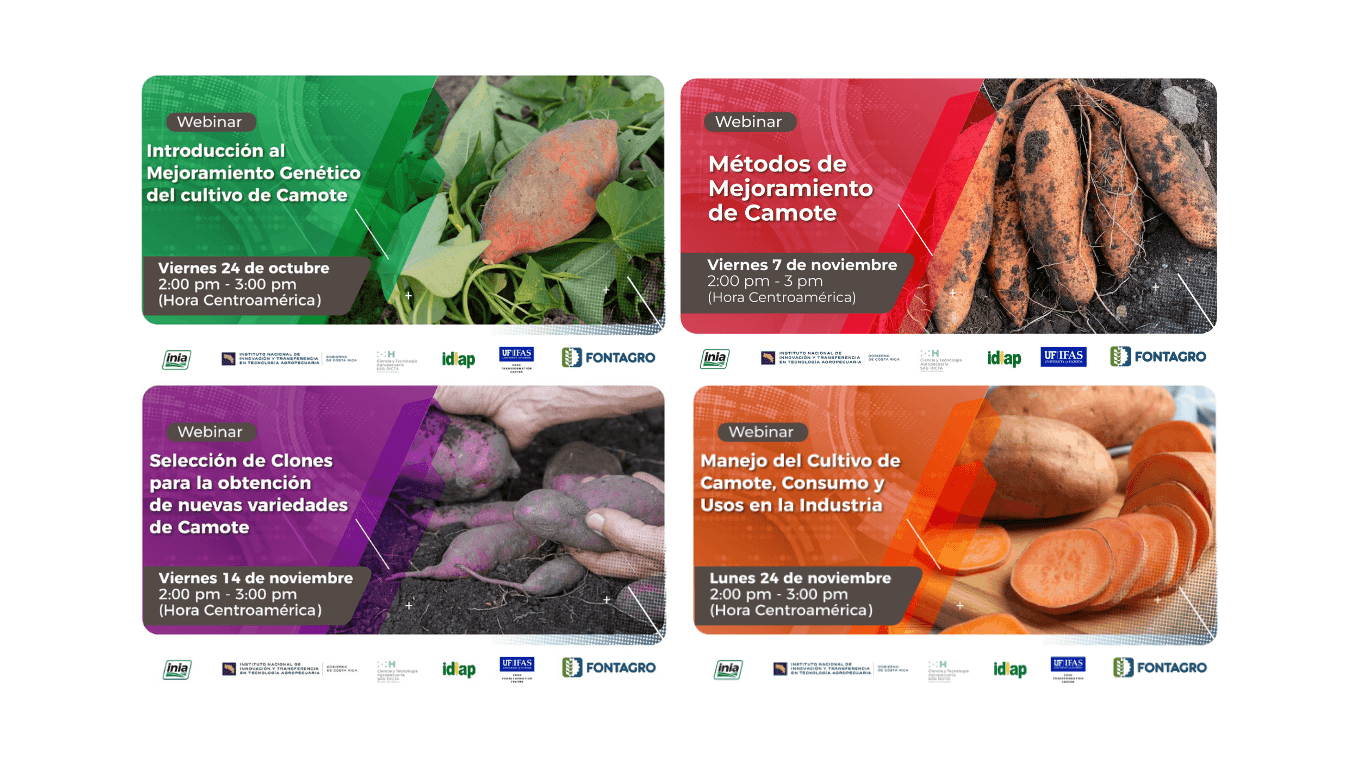
As part of the project co-financed by FONTAGRO: Regional Network for Genetic Improvement in Latin America and the Caribbean, a series of four webinars was held, focusing on promoting resilient and nutritious agriculture in the region. This project is executed by the National Institute of Innovation and Technology Transfer in Agricultural Technology (INTA - Costa Rica), the Directorate of Agricultural Science and Technology (DICTA SAG - Honduras), the Institute of Agricultural Innovation (IDIAP - Panama), and the National Institute of Agrarian Innovation (INIA - Peru), in collaboration with the University of Florida - United States.
These virtual seminars brought together researchers and producers interested in agricultural innovations, showcasing advancements in developing improved varieties through sexual seeds and advanced clones of sweet potatoes, highlighting their nutritional importance as a vital source of carotenoids and proteins.
Additionally, innovative breeding methods, family selection for developing new varieties, and agronomic management of this crop were discussed. The use of modern technologies, such as artificial intelligence and drones, was emphasized to improve disease detection and optimize cultivation processes. During family selection, strategies for clonal propagation, along with quality concerns crucial for market acceptance, were also discussed.
The final webinar focused on the impact of sweet potatoes in the industry, underlining a remarkable growth in production in Latin America, where Peru has reached 300,000 tons annually. Challenges such as viral contamination and pests were addressed, along with advancements in the selection of resistant genotypes.
The series of webinars concluded with a call to action to continue innovating and adapting sweet potato genetic improvement strategies, ensuring that the region's agriculture adapts to future challenges. FONTAGRO's focus on collaboration, funding, and knowledge exchange was reaffirmed as crucial for developing sustainable agriculture in Latin America and the Caribbean.
To view the webinar series, visit here.