• Go to Fontagro's X profile
  • Go to Fontagro's Instagram profile
  • Go to Fontagro's Linkedin profile
  • Go to Fontagro's Youtube profile
  • About Us
  • Governance
    • Governance
    • Our committees
  • Documents
  • News
    • News
    • Events
  • Library
  • Toolkit
Fontagro
  • Menu iconImpact
    • Projects
    • Success Cases
    • Impact Stories
  • Menu iconInitiatives
  • Menu iconDashboard
  • Menu iconAlliances
  • Go to Fontagro's X profile
  • Go to Fontagro's Instagram profile
  • Go to Fontagro's Linkedin profile
  • Go to Fontagro's Youtube profile
Fontagro
Fontagro
  • About Us
  • Governance
    • Governance
    • Our committees
  • Documents
  • News
    • News
    • Events
  • Library
  • Toolkit
  • Menu iconImpact
    • Projects
    • Success Cases
    • Impact Stories
  • Menu iconInitiatives
  • Menu iconDashboard
  • Menu iconAlliances
Fontagro

Innovation ecosystem for the agri-food sector in Latin America and the Caribbean

Newsletter
  • Impact
  • Initiatives
  • Dashboard
  • Alliances
  • About Us
  • Governance
  • Documents
  • News
  • Library
  • Toolkit

Contact Us

  • E-mailfontagro@iica.int
  • LocationIICA USA - 1889 F Street, N.W., Suite 360 Washington, D.C. 20006
  • Terms, conditions and privacy policy

© 2026 Fontagro. All Rights Reserved

  • Go to Fontagro's X profile
  • Go to Fontagro's Instagram profile
  • Go to Fontagro's Linkedin profile
  • Go to Fontagro's Youtube profile
impact story image
View project

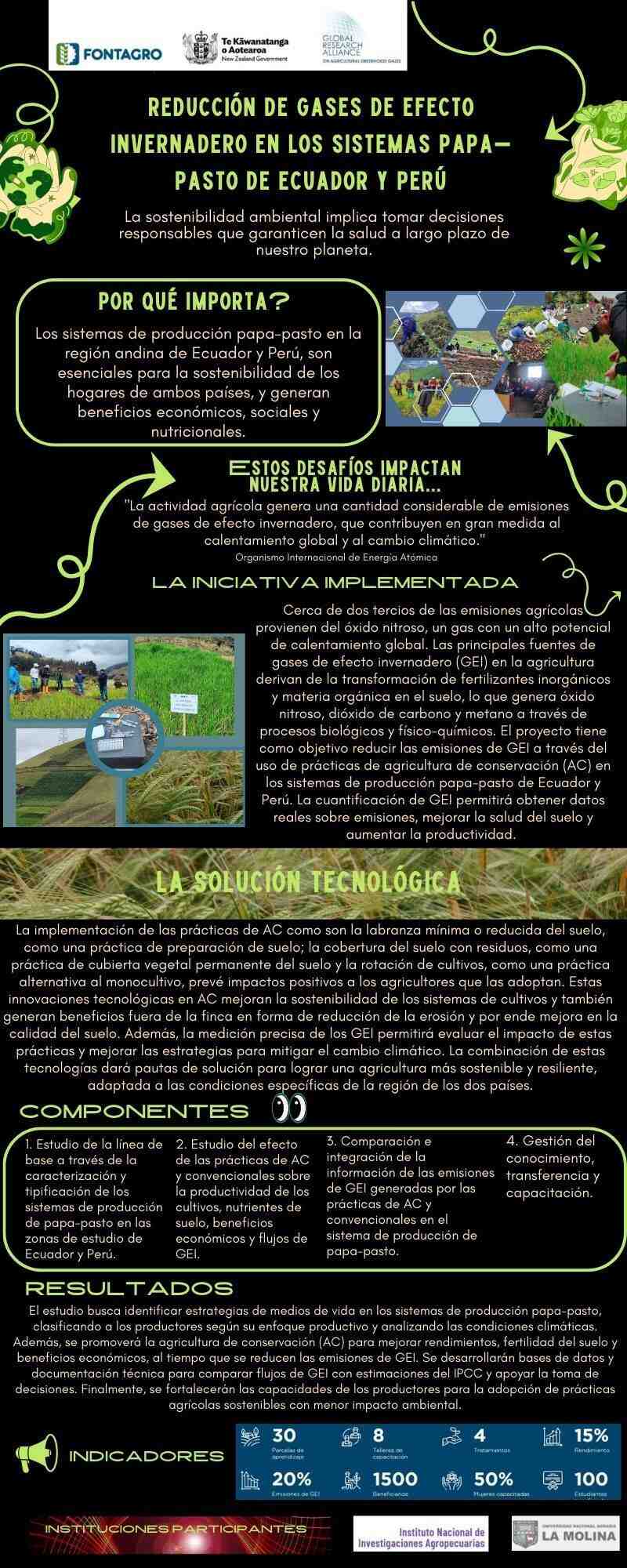
Reducing greenhouse gas emissions in potato-pasture production systems in Ecuador and Peru

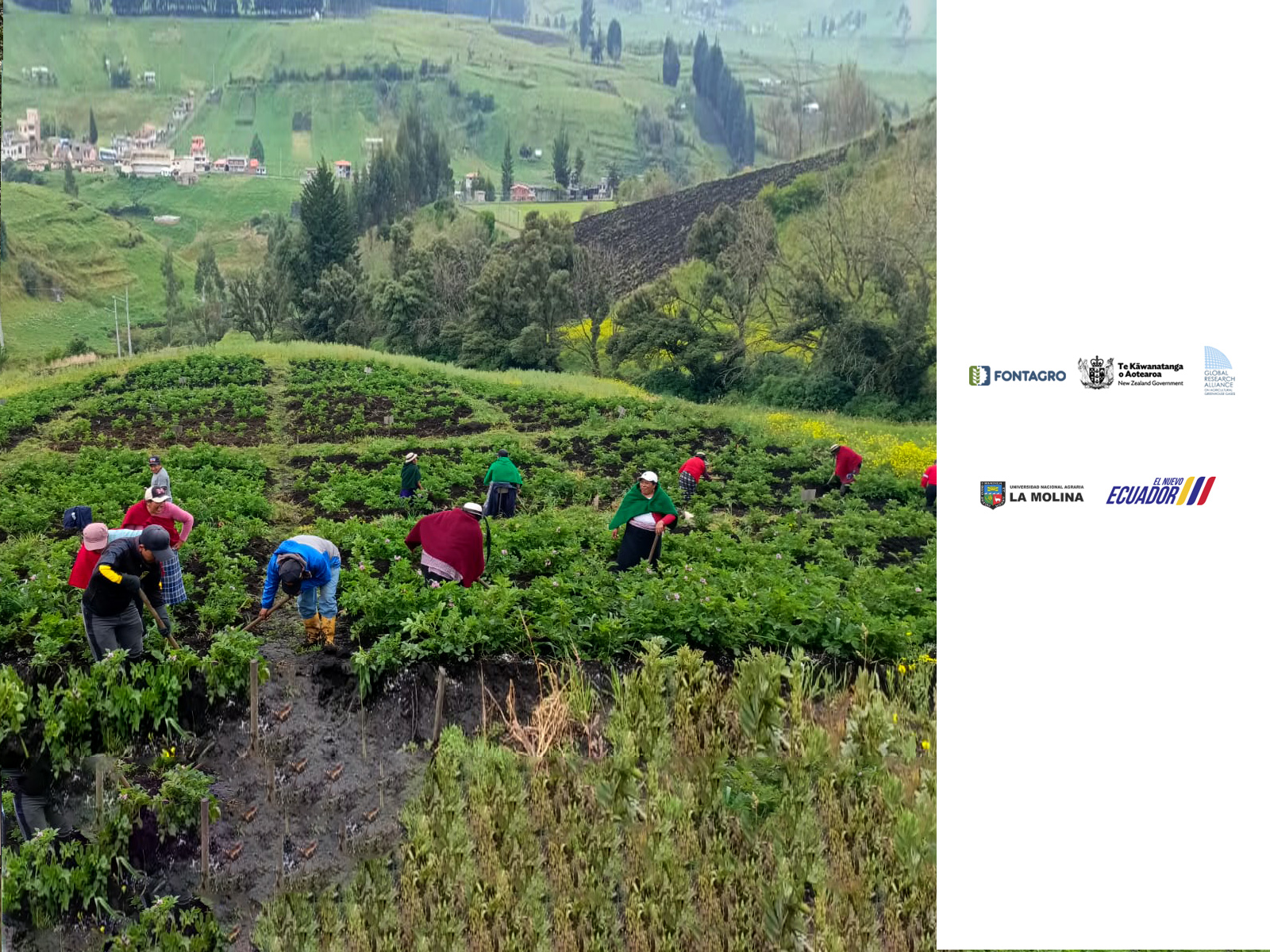
The potato-pasture production systems in the Andean region of Ecuador and Peru are essential for household sustainability in both countries, generating economic, social, and nutritional benefits.

X iconFacebook iconLinkedin icon
Summary icon

Context of the story

Potato-pasture production systems are key agricultural production systems in the Andean region of Ecuador and Peru. In potato cultivation, planted areas have decreased by more than half, while yields have increased, possibly due to the increased application of agrochemicals, which may lead to soil infertility issues. For pastures, the expansion of planted areas has been driven by the high unmet demand for milk and dairy products. These systems rely on specific management practices: in potato cultivation, excessive soil tillage and indiscriminate use of nitrogen fertilizers are common, while in pasture systems, the main challenge is inefficient management.
Summary icon

This study analyzes strategies to mitigate greenhouse gas emissions in potato-pasture production systems in Ecuador and Peru.

The Implemented Initiative

Approximately two-thirds of agricultural emissions come from nitrous oxide, a gas with a high global warming potential. The main sources of greenhouse gas (GHG) emissions in agriculture stem from the transformation of inorganic fertilizers and organic matter in the soil, generating nitrous oxide, carbon dioxide, and methane through biological and physicochemical processes. The project aims to reduce GHG emissions by implementing conservation agriculture (CA) practices in potato-pasture production systems in Ecuador and Peru. GHG quantification will provide real data on emissions, improve soil health, and enhance productivity.
Inititiative image
Summary icon
Sustainable strategies to mitigate the environmental impact of agricultural production.

The technological solution

The implementation of conservation agriculture practices, such as minimum or reduced tillage, soil cover with residues, and crop rotation, is expected to have positive impacts on farmers who adopt them. These technological innovations in conservation agriculture enhance the sustainability of cropping systems and provide additional benefits beyond the farm, such as reduced soil erosion and improved soil quality. Additionally, the precise measurement of GHG emissions will allow for the evaluation of these practices' impact and the refinement of strategies to mitigate climate change. The combination of these technologies will help provide guidelines for achieving a more sustainable and resilient agriculture, adapted to specific regional conditions in both countries.
Quote background
"Agricultural activity generates a considerable amount of greenhouse gas emissions, which significantly contribute to global warming and climate change."
— International Atomic Energy Agency. (n.d.)
Loading map...

Type of project

Agronomic PracticesAgronomic PracticesGenetic ResourcesGenetic ResourcesTechnologicalTechnologicalCropsCrops
Summary icon

Results

The study aims to identify livelihood strategies in potato-pasture production systems, through the classification of producers based on their productive approach and the analysis of climatic conditions. Additionally, conservation agriculture will be promoted to increase yields, soil fertility, and economic benefits, while reducing GHG emissions. Databases and technical documentation will be developed to compare GHG fluxes with IPCC estimates and support decision-making. Finally, farmers' capacities will be strengthened to adopt sustainable agricultural practices with lower environmental impact.
Learning plots
40
Learning plots
Training workshops
8
Training workshops
Treatments
5
Treatments
Yield
+15%
Yield
GHG emissions
-20%
GHG emissions
Beneficiaries
1500
Beneficiaries
Trained women
50%
Trained women
Benefited students
100
Benefited students
Comunidad Santa Isabel
Iniciaiva
Proyecto
Cultivating a Sustainable Future: Strategies to reduce GHG in potato-pasture systems of Ecuador and Peru

Participating Organizations

 - Ecuador

Ecuador

 - Perú

Perú

 - Sede Central

Sede Central

Main Donors

 - undefined
 - undefined
 - undefined

Project information

Learn moreProject technical specificationsProject News
Responsible consumption and productionClimate actionLife on landPartnerships for the goals
Responsible consumption and production
Climate action
Life on land
Partnerships for the goals

Other Impact Stories

The Tangible Impact of Science and Technology in the Field

Story image
Regional control platform for bovine leukosis
Story image
Biointensive Cultivation of the Dry Corridor
Story image
RedLAC Beekeeping Platform