• Go to Fontagro's X profile
  • Go to Fontagro's Instagram profile
  • Go to Fontagro's Linkedin profile
  • Go to Fontagro's Youtube profile
  • About Us
  • Governance
    • Governance
    • Our committees
  • Documents
  • News
    • News
    • Events
  • Library
  • Toolkit
Fontagro
  • Menu iconImpact
    • Projects
    • Success Cases
    • Impact Stories
  • Menu iconInitiatives
  • Menu iconDashboard
  • Menu iconAlliances
  • Go to Fontagro's X profile
  • Go to Fontagro's Instagram profile
  • Go to Fontagro's Linkedin profile
  • Go to Fontagro's Youtube profile
Fontagro
Fontagro
  • About Us
  • Governance
    • Governance
    • Our committees
  • Documents
  • News
    • News
    • Events
  • Library
  • Toolkit
  • Menu iconImpact
    • Projects
    • Success Cases
    • Impact Stories
  • Menu iconInitiatives
  • Menu iconDashboard
  • Menu iconAlliances
Fontagro

Innovation ecosystem for the agri-food sector in Latin America and the Caribbean

Newsletter
  • Impact
  • Initiatives
  • Dashboard
  • Alliances
  • About Us
  • Governance
  • Documents
  • News
  • Library
  • Toolkit

Contact Us

  • E-mailfontagro@iica.int
  • LocationIICA USA - 1889 F Street, N.W., Suite 360 Washington, D.C. 20006
  • Terms, conditions and privacy policy

© 2026 Fontagro. All Rights Reserved

  • Go to Fontagro's X profile
  • Go to Fontagro's Instagram profile
  • Go to Fontagro's Linkedin profile
  • Go to Fontagro's Youtube profile
impact story image
View project

Nanotechnology for soil moisture management in agricultural lands of the Andean Region

A project to be carried out in the Andean regions of Bolivia and Ecuador will develop nanoclays and hydrogels to improve soil moisture retention, mitigate drought, and adapt crops to new climate scenarios.

X iconFacebook iconLinkedin icon
Summary icon

Context of the story

The Andean region of Bolivia and Ecuador is experiencing significant shifts in climate patterns. Droughts are recurrent, severely affecting agricultural productivity, food security, and the local economy. It is essential to develop adaptation strategies that help farmers mitigate the negative effects of climate variability and drought. These countries are home to unique ecosystems that are also under threat from climate change. Protecting these ecosystems is vital to preserving biodiversity and essential ecosystem services.
Summary icon

Promoting sustainability and resilience in fragile Andean agroecosystems through nanotechnology for efficient soil moisture management to enhance productivity and crop diversification.

The Implemented Initiative

Research institutions in Bolivia and Ecuador, together with the agricultural production sector in the Andean region, aim to promote the sustainability and resilience of fragile Andean agroecosystems through efficient soil moisture management. This will help increase productivity and crop diversification as a food security and climate adaptation strategy. The project will develop nanoclays and hydrogels to improve soil moisture retention capacity, which will be participatively evaluated and validated in various crops and agroecosystems across Bolivia and Ecuador. Results will be disseminated through regional soil moisture management platforms.
Inititiative image
Summary icon
Development of nanoclays and hydrogels to reduce soil moisture loss, improve productivity, and promote crop diversification in fragile Andean agroecosystems.

The technological solution

The project strategy is based on the development and use of nanoclays and hydrogels. Nanoclays consist of ultra-fine particles with a high surface area and expansion capacity, allowing them to retain large volumes of water. Hydrogels are made from cellulose fibers derived from agricultural waste and are low-cost and environmentally friendly, making them ideal for agricultural use. After laboratory development, both materials will be tested and validated in fragile Andean agroecosystem soils to evaluate their effects on water retention, microbial diversity, and agricultural productivity.
Quote background
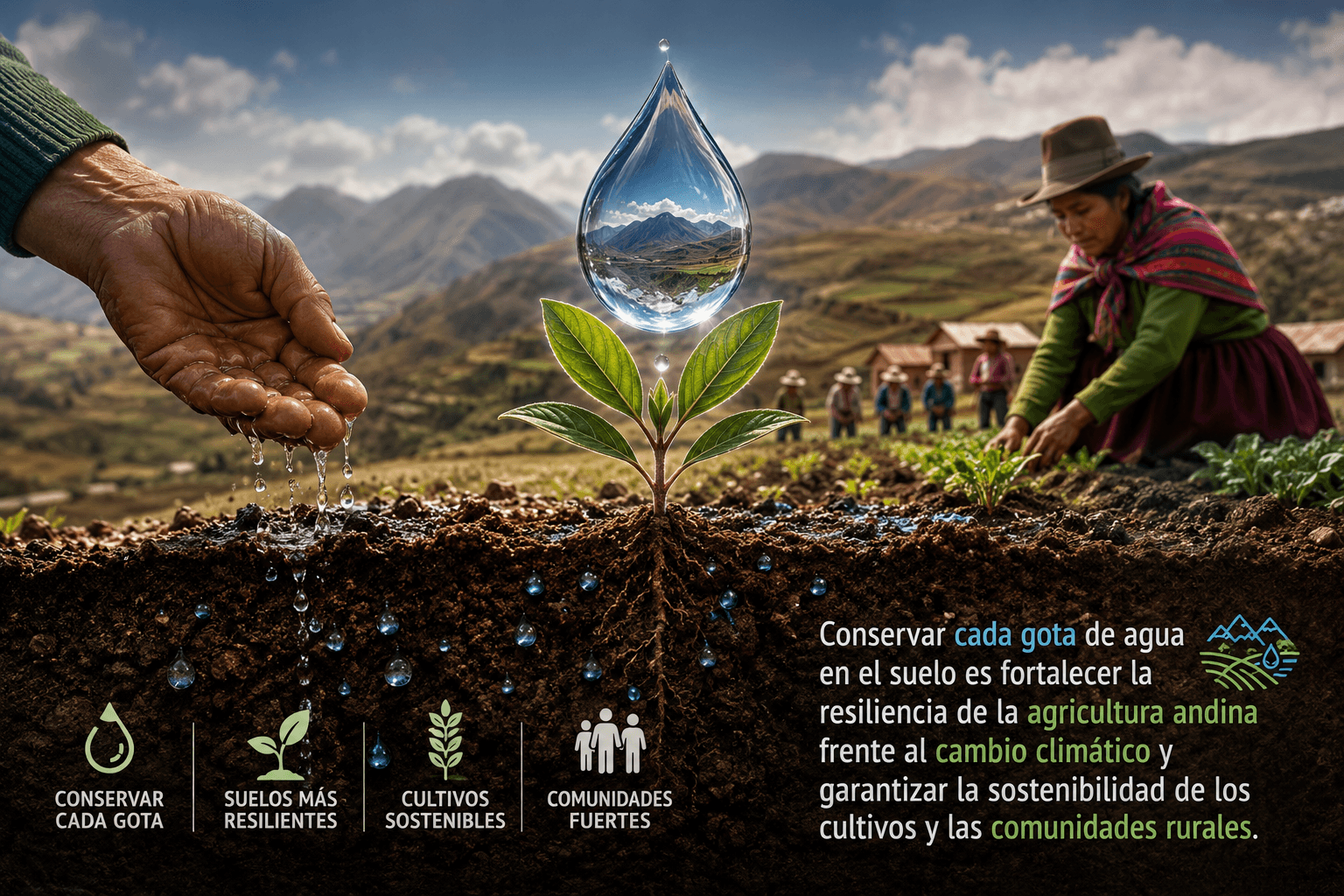
"Conservar cada gota de agua en el suelo es fortalecer la resiliencia de la agricultura andina frente al cambio climático y garantizar la sostenibilidad de los cultivos y las comunidades rurales."
— Inspirado en los principios de adaptación climática y manejo sostenible del suelo promovidos por la FAO y el IPCC.
Loading map...

Type of project

Agronomic PracticesAgronomic PracticesGenetic ResourcesGenetic ResourcesTechnologicalTechnological
Summary icon

Results

Different nanoclays and organic hydrogels were evaluated for their water absorption and retention capacity. The nanoclays were obtained from clay deposits in Ecuador and processed by grinding and sieving, while the hydrogels were produced from organic residues. Water retention varied according to nanoclay type and concentration. Among the hydrogels, those derived from borojó and sugarcane showed the highest performance, with absorption capacities exceeding 200%. During the 2025–2026 cropping season, both technologies improved quinoa and wheat productivity, with optimal application dose of 1,000 kg/ha of nanoclay and 100 kg/ha of hydrogel. Effects were less evident in potato and could not be assessed in maize due to hail damage. Additionally, 2,000 technical factsheets were produced, 330 farmers were trained, and a Virtual Learning Community was established to support technology dissemination and adoption.

Summary icon

Relevant data

Más de 330 productores capacitados, 8 talleres realizados, 2000 fichas técnicas generadas y distribuidas. Ensayos en quinua, trigo, papa y maíz para validar nanoarcillas e hidrogeles en Bolivia y Ecuador.

Absorption capacity of borojó and sugarcane hydrogels
+200%
Absorption capacity of borojó and sugarcane hydrogels
Crops with improved field productivity
+2
Crops with improved field productivity
Producers trained
+330
Producers trained
Workshops held
8
Workshops held
Technical factsheets produced and distributed
+2000
Technical factsheets produced and distributed
Members registered on the digital innovation platform
+30
Members registered on the digital innovation platform
Video preview
Evaluando quinua en Bolivia
Cosecha del ensayo de quinua en Bolivia
Demostración de la capacidad de retención de humedad de los suelos por efecto de nanoarcillas e hidrogeles
Ensayo de trigo en Bolivia
Ensayo de trigo en Ecuador
Ensayo de quinua en Ecuador
Nanotecnología para la gestión de humedad en suelos agrícolas andinos: innovación frente a la sequía y el cambio climático

Participating Organizations

 - Ecuador

Ecuador

FLORIDA - Bolivia

SANTAMARINA - Bolivia

IBAGROCEREAL - Bolivia

 - Sede Central

Sede Central

 - Bolivia

Bolivia

 - Ecuador

Ecuador

 - Ecuador

Ecuador

 - Bolivia

Bolivia

 - Bolivia

Bolivia

 - Ecuador

Ecuador

 - Ecuador

Ecuador

FLORIDA - Bolivia

SANTAMARINA - Bolivia

IBAGROCEREAL - Bolivia

 - Sede Central

Sede Central

 - Bolivia

Bolivia

 - Ecuador

Ecuador

 - Ecuador

Ecuador

 - Bolivia

Bolivia

 - Bolivia

Bolivia

 - Ecuador

Ecuador

 - Ecuador

Ecuador

FLORIDA - Bolivia

SANTAMARINA - Bolivia

IBAGROCEREAL - Bolivia

 - Sede Central

Sede Central

Main Donors

 - undefined

Project information

Learn moreProject technical specificationsProject News
Zero HungerClimate action
Zero Hunger
Climate action

Other Impact Stories

The Tangible Impact of Science and Technology in the Field

Story image
Adaptation to climate change: silvopastoral systems in Central America
Story image
Changes in Water Productivity in the Southern Cone
Story image
Protected Horticulture